

Shipping faster than we can keep it running
AI made writing code cheap. Running it in production did not get any easier, and the gap between the two is where today's incidents come from.
By Pooné Mokari, Co-founder of ewake
Writing the code is no longer the hard part
Until recently, most of the discussion around AI in software engineering focused on how well it could write code. Most benchmarks reflected that focus, measuring whether AI could fix bugs, pass tests or complete coding tasks.
As AI makes writing code easier, understanding how that code behaves in production, interacts with existing systems and fails becomes increasingly important.
Production is where the bill arrives
Over the past year, several high-profile incidents have shown the risks of deploying AI-assisted code without sufficient safeguards.
- AWS, December 2025. Kiro, Amazon's AI coding agent, was reported to have deleted and recreated an environment, leading to a 13-hour outage. Amazon attributed it to user error and misconfigured access, not to the AI itself.
- Amazon retail, March 2026. A wave of outages hit the main site in a single week, with internal documents linking them to AI-assisted code changes. The worst, on March 5, lasted around six hours. Amazon responded by requiring senior sign-off on AI-assisted changes from junior and mid-level engineers.
- Google, May 2026. A Gemini coding agent was reported to have removed around 30,000 lines of production code, triggering a 33-minute outage.
In an October 2026 report from Undo, 81% of engineering leaders said their organisation had a production incident linked to AI coding tools in the previous six months. The same report found that 35% of AI-generated code reaches production before teams fully understand it.
After these incidents, much of the discussion focused on whether the AI or the engineer approving the change was responsible. But the bigger issue is how these changes made it into production in the first place.
Two speeds, one production system
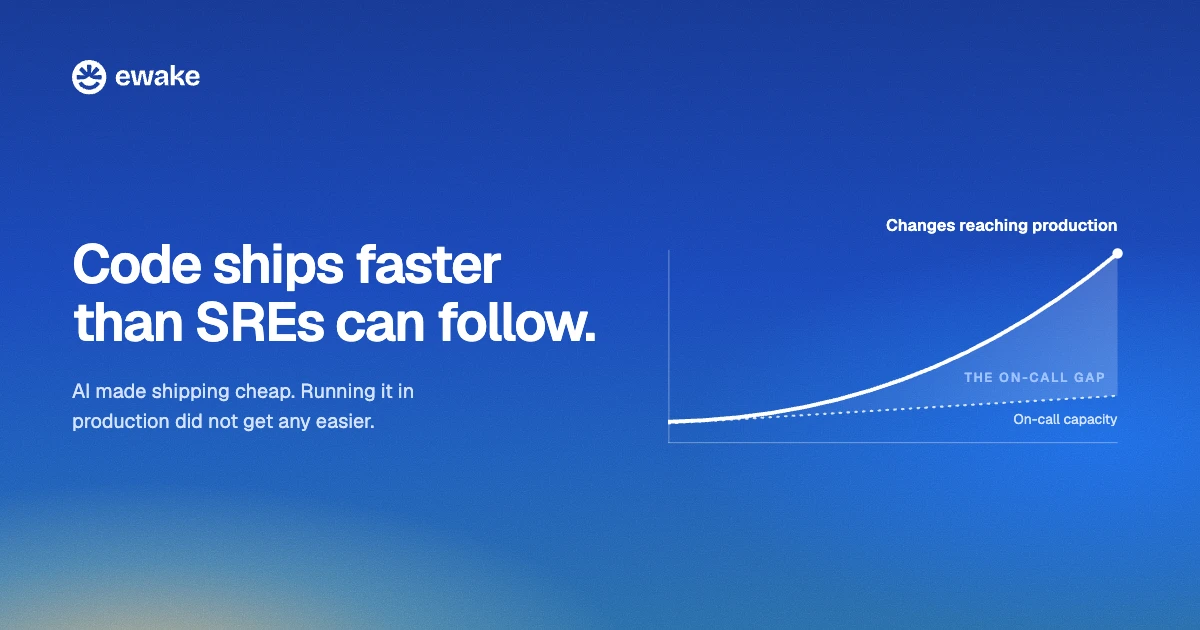
AI is changing how quickly teams can develop and ship code, but the way we operate and maintain that code hasn't kept up.
With AI coding tools, engineers can produce more code and ship changes faster, increasing the number of pull requests and deployments teams have to manage. Code review is already stretched, and the person approving a change often did not write it and cannot fully reason about it.
On the operations side, very little has changed. The on-call engineer still gets paged at 3am, opens five dashboards, scrolls through logs and tries to rebuild the context of a change they have never seen. Runbooks are written by hand and go stale. Alert volumes grow with every new service. SRE teams were not staffed for this pace, and they are not growing at the same rate as the code they protect.
The result is a widening gap:
- More change, less context. Every deploy adds risk, and fewer people understand each change deeply.
- Detection lags behind delivery. Problems surface in production, through customers or alerts, long after the change that caused them.
- Accountability gets blurry. When something breaks, the debate becomes "the AI or the human?" instead of "how did this reach production unnoticed?"
- Manual gates as the default fix. Senior sign-off and code freezes slow everyone down without closing the gap.
So how do we bridge the gap?
As AI increases the volume of code reaching production, teams need to improve both how quickly they investigate failures and how effectively they use those findings to prevent future incidents.
Today, much of what teams learn from production incidents stays in observability tools, incident reports and runbooks, disconnected from the development process. Making that knowledge available to developers and coding agents could help them catch similar issues before they reach production. But simply giving agents access to more logs and metrics isn't enough. They need relevant evidence about what failed before, why it failed and whether a proposed change actually fixes the underlying problem.
If AI is accelerating how we build software, it has to accelerate how we run it too. That is the gap we will explore in the next articles of this series.
Sources
See ewake on your own stack
The fastest way to understand ewake is to point it at something real.