All articles
Vision
·
·
3
min read
Fast Code or Fragile Systems
Fast Code or Fragile Systems
A few years ago, opening GPT-3, pasting a function, and watching a reasonable implementation appear felt almost magical.
At the time, it was hard to imagine how quickly that feeling would become normal.
Today, AI-assisted coding is part of everyday engineering. The question is no longer if teams will adopt AI; that decision has already been made. The more interesting question now is where AI actually belongs in the engineering workflow.
Most engineers no longer see AI as a threat. It’s a force multiplier or a baseline raiser.
We’re seeing a new generation of code agents raise the baseline for software delivery. With tools like OpenAI Codex and Devin, teams can now ask an agent to implement a feature, wire it to existing services, generate tests, and iterate on feedback — tasks that previously required multiple handoffs across a sprint.
Humans acting as orchestrators, guiding, validating, and managing intelligent systems, is no longer a future concept. It’s already happening.
But there’s a deeper truth we don’t talk about enough.
Most Engineering Time Is Not Coding
Pure coding often accounts for only about 16% of an engineer’s time.
The lack of investment in resolving real developer friction shows up clearly in Atlassian’s 2025 survey results: much of the remaining 84% of engineering time is lost to finding information, switching between tools, meetings, and coordination.
Code that never survives production is not velocity; it’s friction.
Real engineering speed isn’t about how fast code is written but it’s about how reliably it runs in production.
Engineers Spend Most of Their Time Between Tools
If we look closely at how engineers actually work, especially under pressure, the pattern is clear.
We jump from logs to traces.
From metrics back to code.
From dashboards to incident timelines.
We correlate signals, form hypotheses, test them, revise them, and repeat. Understanding doesn’t live in a single place; it’s built between tools.
Most AI agents today don’t operate there.
They live inside an IDE, a chat window, or a ticketing system. They’re great at generating code, but they don’t understand why that code failed in production. They don’t see system behavior, operational history, or real business impact. And without that context, they can’t meaningfully help when things go wrong.
That’s Why AI Needs to Understand Production Env
If we want to unlock the full value of AI agents, they can’t stop at code.
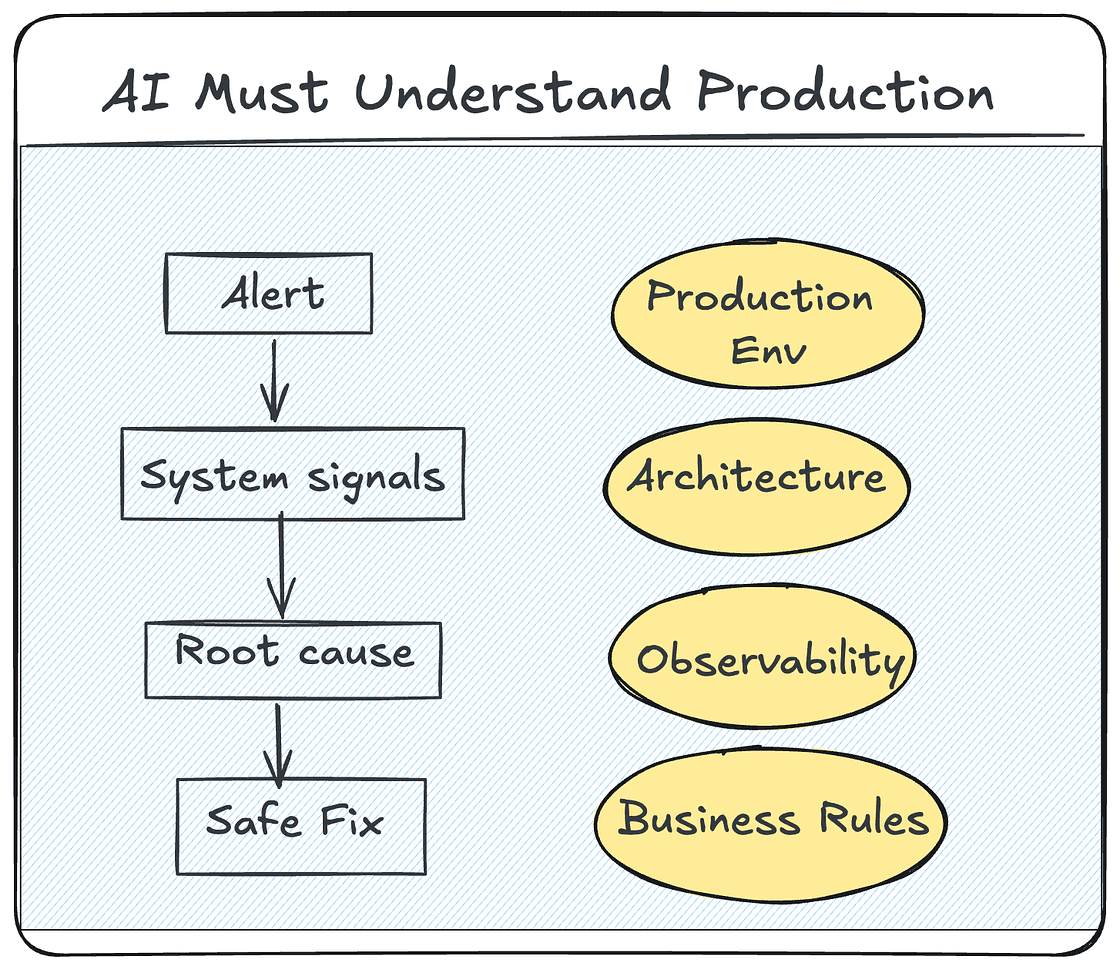
They need to understand:
the production environment
the system architecture
observability signals
business logic and constraints
An effective AI agent should be able to follow an issue from a production alert, through system behavior, all the way back to the root cause in code — and forward again to a safe, confident fix.
AI should reduce incidents, not introduce new ones. It should help teams ship with confidence and not just speed.
Press enter or click to view image in full size
The Future: AI Where Engineers Actually Work
If engineering happens between tools, then AI agents have to live there too.
They need to be a continuous layer, the one that understands context, connects signals, and helps engineers make better decisions in real time, especially in production, where the stakes are highest.
That’s the future we believe in at ewake.ai.
And it’s the future engineering teams deserve.